 |
| A brave journey to discover the melting of the biggest glacier on earth. |
“Chasing Ice": a scientific prove that climate change is a real problem.
The documentary “Chasing Ice”, directed by Jeff Orlowski, presents the
work of environmental photographer James Balog, who headed to the Arctic in order to study
the melting of the giants glaciers. Balog’s have captured vivid and unique images
in a period of five years; his project is known as EIS (Extreme Ice Survey). He
has work by installing a total of 24 cameras: 12 in Greenland, 5 in Iceland, 5
in Alaska, and 2 in Montana, US. During the film, Balog confirms his skeptical
attitude towards climate change in the past 25 years, because he couldn’t
believe that chemicals can destroy or cause harm to our planet earth. Then, he mentions that during the previous
five years to his project, he started to think seriously about climate change,
then, he got the brilliant idea of work in the EIS.
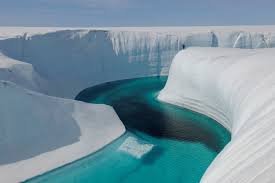 |
| The melting of the glaciers captured by Balog's camera during his project |
During the documentary, Dr. Tad Pfeffer, glaciologist of the University
of Colorado, states: “ as glaciologist, we look the chemical composition of ice
by measuring the past temperature and its relationship with Carbon Dioxide.
During the past 100 hundred years both parameters were moving together in a
natural way, there was only one time when the CO2 increases to 280 parts per
unit, but it had happened for natural reasons. Now, we have 390 parts per unit
(40% of increase) And even worse, we have to be prepared to expect 500 or more
part per units in the next 10 years”
 |
| Graph presented by Dr. Pfeffer during the documentary showing the relationship of CO2 and Ice temperature |
In addition, during the documentary, Dr. Terry Root, from the Woods
Institute, of Stanford University spokes about the endangered species. Dr. Root
states: “ As a planet continue to warm, we are going to be losing more species
every day. In the past 100 years we have experienced the greatest animal mass extinction
after the Dinosaurs’ era. Moreover, a
mass extinction event means that we are going to lose ½ or ¾ number of species
that we have in our planet. Also, we would lose our plants and threes, because
if there are not pollinators, we have to do it by hand, as China is doing it
right now”.
 |
| Polar Bear is one of the thousand of endanger species on our planet |
 |
| A New Mexico fire, during 2002. |
Another important recommendation during the movie is made by Dr. Thomas
Swetnam, Director of Tree Research Institute, University of Arizona. Dr. Swetnam
asserts: “In the past 20 years, we have lost more than 20% of our forests in
Arizona and New Mexico. The highly mortality of this areas, as at the western
of the United States is the result of the climate change. Since earth is
getting hotter and hotter, arid areas of our planet are more vulnerable to set
in fire by natural causes, as lighting during light storms.
 |
| Fires have increased in the past 20 years due to climate change, specifically in Arizona, New Mexico, and Western US |
To conclude with this documental, James Balog presents
the result of its first five years project, where a person can visualize the
impact that climate change has done to our environment during his
experiment. Balog deploys revolutionary
time-lapse cameras to capture a multi-year record of the world's changing
glaciers. His hauntingly beautiful videos compress years into seconds and
capture ancient mountains of ice in motion as they disappear at a breathtaking
rate. Traveling with a team of young adventurers across the brutal Arctic,
Balog risks his life and career in pursuit of the biggest story facing
humanity. As the debate polarizes America, and the intensity of natural
disasters ramps up globally, Chasing
Ice depicts a heroic photojournalist on a mission to deliver
fragile hope to our carbon-powered planet. In addition, Chancing Ice is a heart-stopping
in its coverage of the brave and risky attempt by scientist/photographer James Balog and his
team of researchers on the Extreme Ice Survey, where "extreme" refers
to their efforts almost more than to the ice. This documentary is scientific
evidence that climate change it is a real problem and we as human beings have
to do our best in order to care our planet. Finally, I would say that I have
contacted James Balog office in order to know why he didn't include the Antarctica
(South America) to make it global; immediately, I have gotten a same day
response telling me that the project is still working, now they have installed a
couple of cameras in Bolivia, with major planes to reach other cameras sooner in Argentina. My last phrase to say about it is: Please, as student, as human
beings, we have to support James Balog and his EIS Project, for more info to do
so, please contact his page at http://extremeicesurvey.org/
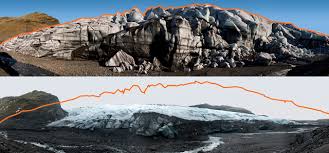 |
| Representation of how he has founded the glacier in 2007, the next picture presents the change of the glacier in 2012. |

No comments:
Post a Comment